
In part 1 I described a teammate’s question getting a written-up answer in Slack while I was busy with something else. This post is about the agent that writes those answers.
I named it kenny, after Ken, because I built it to take the first-response work people used to wait for me to do.
This is part 6 of a series on what I learned putting AI agents to work in my own job.
What “my job” means here
One of my jobs is first response when something goes wrong in the running service. Someone reports it in Slack. I work out what it is: reproduce it, read the code. If it needs a fix, I open an issue and fix it, and along the way I tell people what’s happening and what to do in the meantime.
The bottleneck was my availability. When I was deep in something else, I didn’t see the request or couldn’t get to it, and the person who asked was blocked until I did.
So before writing a line of configuration, I wrote down which parts of that job an agent should take and which it shouldn’t:
- Take: receiving the question, finding the answer in the docs and code, checking the current data, reproducing suspected bugs, writing up the cause and a suggested fix, and keeping the person who asked informed.
- Keep: deciding policy and exceptions, promising anything, changing production, and making the fix. The fix stays with me, made from the write-up.
That list became the agent’s rules almost line for line. kenny runs on Hermes Agent, the open-source agent runtime, in Slack.
One front door, two specialists
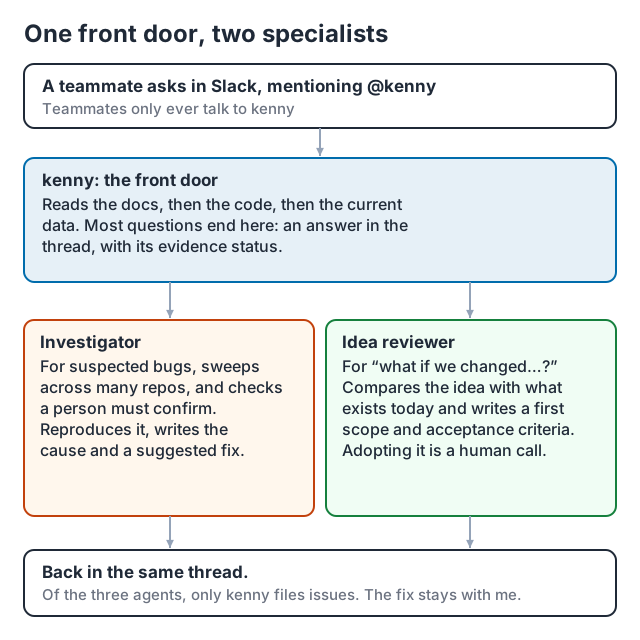
Teammates only ever talk to kenny. Behind it are two specialist agents that only kenny talks to:
- An investigator. It reproduces suspected bugs in a development environment, finds the cause, and writes the cause and a suggested fix. It may edit code there to confirm a cause, and it always reverts the edit; the real fix is made by a person from the write-up.
- An idea reviewer. When someone asks “what if we changed…?”, it compares the idea with what exists today and writes a first scope with acceptance criteria. It can read but not run anything. Whether to adopt the idea is a human call, and kenny asks the person first before sending an idea for review.
kenny sends only three kinds of work to the investigator: suspected bugs, sweeps that cut across many repositories, and investigations that need a person to confirm something. Feature ideas follow the separate review path above. Everything else kenny answers itself. The results come back to the same Slack thread, and of the three agents, only kenny files issues in the tracker, so there’s one voice in the thread and one agent that writes issues.
The handoff rule came from the first real case. kenny held on to a bug for too long, doing the investigator’s work in the front door. The rule now says: point at where the problem is, hand it off quickly, and tell the person “received, here’s my first read”.
The front door turned out to carry most of the load. In one week in early November, the investigator got no cases at all: kenny answered every question directly.
An answer format that admits doubt
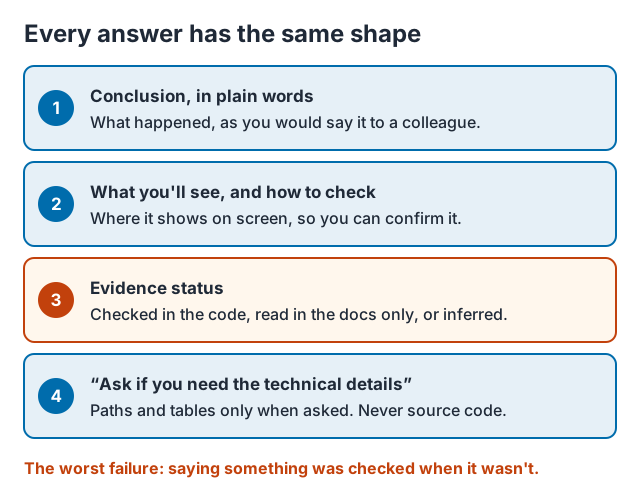
The most important rule isn’t about what kenny knows. It’s about how it says what it doesn’t. Every answer includes its evidence status: checked in the code, read in the docs only, or inferred. In kenny’s own rules, the worst failure is saying something was checked when it wasn’t.
The rest of the format came from feedback. Within the first week, people said the answers were too technical. So the default changed: a conclusion in plain words first, then what they’ll see on screen and how to check it, then the evidence status, then an offer of the technical details. File paths and tables appear only when someone asks, and source code never does.
Two smaller rules do a lot of work:
- The code wins. For the conditions that decide a policy question, kenny checks the code, not just the docs, because some docs are still drafts.
- It only answers when mentioned. In a channel, kenny responds to
@kennyand stays out of conversations between people.
From “here’s the SQL” to “here’s the number”
For its first few days, kenny could only read an older copy of the data. Asked “what’s this order’s status right now?” or “how many were auto-rejected this week?”, the best it could do was answer from that copy or suggest a query someone else could run.
Then I connected it to a read-only view of the live data with personal data masked. Now it answers with the current value. The rules around that access are strict: it doesn’t select personal-data fields, it carries only counts and identifiers into Slack or issues, it has a small query budget per question, and if a lookup fails it says the value wasn’t checked rather than guessing.
Deliberately narrow
kenny could do more. It doesn’t, on purpose:
- No policy and no promises. Exceptions, compensation and “we’ll fix that” come from a person. When a question needs a decision, kenny mentions me in the thread.
- No production changes. It can’t deploy, change data or change settings. It reads.
- No personal data in the open. Order and member IDs only; names, contact details and payment details never go into Slack or issues.
- No source code in Slack. It may read code to reason, but it doesn’t post it. That guard is the subject of my first post.
- Its rules don’t change through chat. Not even when I’m the one asking.
So kenny’s answers are material for a decision. The decision, and anything said to a customer, stays with a person.
What it changed
- Built in three days. Built from 17 to 19 October: kenny first, then the investigator, then the idea reviewer. By the 20th, six people had access, and eleven investigations and reviews were complete.
- Fast first answers. From 31 October to 14 November it answered about 95 questions from five people, me included. The median time to a first answer was 93 seconds, and 94 of the 95 got one within ten minutes. One answer I measured in detail took about 30 seconds and five lookups.
- Issues that arrive written up. In its first month it filed two dozen issues from Slack requests, each investigated and written up, so whoever fixes it starts from the cause and a suggested fix.
The sample is small and many of the questions were mine. These numbers show speed, not answer quality or hours saved. But speed was the problem I set out to fix: the question no longer waits for me.
What I’d tell someone building one
- Name the job, not the bot. Write down which part of your work the agent takes and which it doesn’t. That list is most of its rules.
- Give people one front door. Specialists behind it keep each agent’s permissions small.
- Hand off fast. A front door that does deep work becomes the new bottleneck.
- Make doubt part of the format. An evidence status on every answer tells people when to double-check.
- Narrow beats clever. Every capability you leave out is a failure you don’t have to guard against.
- Let feedback change the defaults. One complaint about jargon rewrote every answer after it.
The series
- From doing the work to delegating it
- Let code decide, let the LLM explain
- The rules I never break
- Context is the job
- Agents forget, so I write it down
- kenny: an agent that does my job (this post)
- Hermes: reminders that carry the check
- How to start in two weeks
If you built an agent to take one part of your job, what would you name it, and what would you forbid it to do?